Why Monthly Giving Matters More When Donor Growth Is Uneven
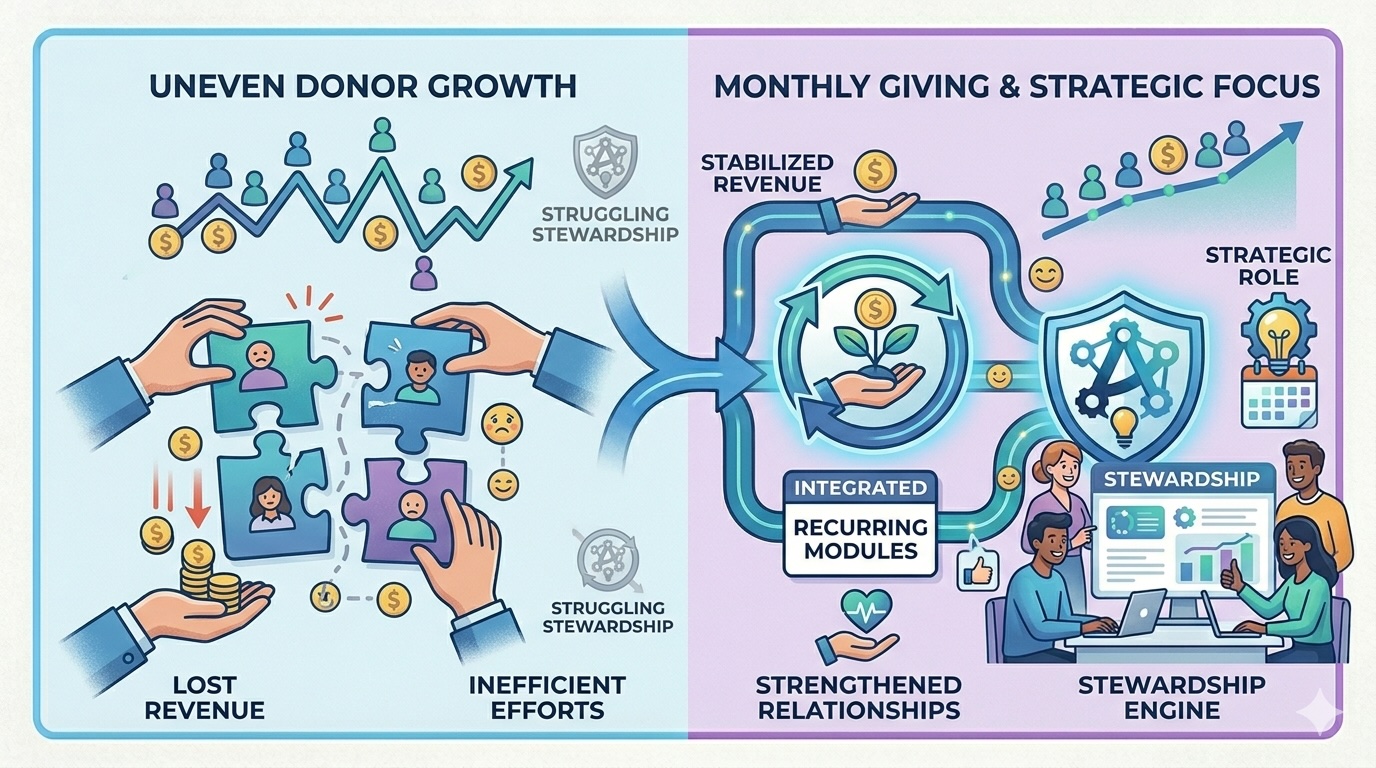
Recurring giving is sometimes framed as a tactical fundraising program, useful but secondary to annual campaigns, major gifts, or year-end appeals. That framing understates its importance.
In the current fundraising environment, monthly giving is increasingly strategic.
Recent sector data suggests that the pressure points are not distributed evenly. Blackbaud Institute reporting has pointed to continued resilience in overall giving, but with growth concentrated among larger organizations and larger gifts. The Fundraising Effectiveness Project has shown that donor counts remain more fragile than topline dollars, especially among smaller donor segments. M+R Benchmarks reported that monthly giving accounted for 31 percent of all online revenue in 2024 and that revenue from monthly giving grew while one-time online giving was flat.
Taken together, those findings point to a simple conclusion: the organizations that can build predictable, relationship-driven revenue streams are better positioned than those relying too heavily on episodic acquisition and end-of-year variability.
Monthly giving is not only about cash flow
The most obvious benefit of recurring giving is predictability. A strong monthly program smooths revenue and reduces dependence on short windows of performance. For leadership and finance teams, that matters. Planning becomes more credible when a meaningful share of revenue is committed before the next campaign begins.
But the more important benefit may be relational, not financial.
A monthly donor is not just someone who pays in installments. They are someone who has accepted an ongoing relationship with the organization. That changes the stewardship conversation. It also changes the internal definition of success. Instead of asking only how much was raised from a single campaign, the organization can ask whether it is building durable support over time.
The data is telling fundraisers to diversify their revenue base
Too many fundraising conversations still focus on big visible outcomes while underestimating the importance of broad participation. Yet current benchmarking continues to show why both matter.
FEP's 2025 reporting suggested that large and repeat donors are driving much of the sector's growth, while smaller donors remain harder to retain. Blackbaud's 2025 giving spotlight similarly noted that sub-$1,000 giving lagged or declined while larger gifts performed better. That is not an argument against investing in major gifts. It is an argument against leaving the middle and lower parts of the pipeline unattended.
Monthly giving can help rebuild that middle.
A well-run recurring program gives first-time and modest donors a practical next step that is more achievable than a major annual ask and more durable than a one-time transaction. It can serve as both a retention tool and a pipeline development tool.
Why many recurring programs underperform
The organizations that struggle with monthly giving often have not failed because donors dislike the idea. More often, the program has never been fully designed.
Common issues include:
· recurring is technically available but not clearly explained
· the default donor journey remains one-time first and stewardship-light
· confirmation and acknowledgment emails do not distinguish recurring donors from one-time donors
· upgrade paths are unclear
· cancellation, card expiry, and failed payment management are reactive instead of intentional
· reporting treats monthly donors as accounting entries rather than a distinct relationship segment
Recurring programs succeed when the organization treats them as a product with its own message, experience, and stewardship logic.
The donation form still matters more than many teams admit
M+R's website performance findings are especially relevant here. Most nonprofits offer monthly giving as an option, but many still preselect one-time giving on their main donation page. That does not make recurring impossible, but it does signal the organization is still treating the monthly choice as secondary.
There is no universal rule that every organization should preselect recurring by default. Audience, offer, and campaign context matter. What does matter is that the recurring choice be presented intentionally, with language that makes the value clear. Donors should understand what monthly support enables, why it matters operationally, and how easy it is to manage.
The strongest recurring forms avoid vague appeals. They connect a monthly amount to a credible outcome and remove uncertainty about commitment.
Stewardship is where recurring value is won or lost
Many nonprofits put real effort into acquiring monthly donors and too little into keeping them engaged.
That is a mistake because recurring donors are not only valuable due to frequency. They are valuable because they are signaling trust. The organization should respond in kind.
Good monthly stewardship typically includes:
· a distinct welcome experience, not a generic receipt alone
· evidence of impact over time rather than repeated ask language
· occasional reminders that confirm control and transparency
· upgrade invitations that are contextually appropriate, not constant
· meaningful recognition in event, campaign, or annual giving planning
A recurring program becomes stronger when the donor feels they have joined something with continuity and purpose.
Monthly giving should be integrated with events and engagement, not isolated from them
Nonprofits sometimes run recurring giving as a separate fundraising channel. In practice, it should connect to other touchpoints.
Event attendees, volunteers, peer-to-peer participants, and first-time campaign donors may all be strong recurring prospects if the handoff is timely and the message is relevant. That requires the organization to connect behavioral context across its systems. A donor who has just registered for an event should not receive the same follow-up as someone who arrived through a year-end appeal.
That is another reason platform design matters. Monthly giving is easiest to grow when the organization can see the full relationship, not just the latest payment.
A stronger recurring strategy starts with a better operating model
If recurring revenue matters more in a volatile environment, then monthly giving deserves operational seriousness. It should be visible in reporting, embedded in journey design, reflected in segmentation, and supported by platform logic that makes stewardship easier rather than harder.
The goal is not simply to persuade more donors to click the monthly option. It is to create a program that donors trust and teams can manage well.
In a market where broad donor growth is less certain, that kind of stability is not a nice-to-have. It is part of fundraising resilience.
A strong recurring program needs more than a checkbox on the donation form. If your team wants to connect monthly giving with cleaner reporting, better stewardship, and more relevant follow-up, Altrinum can help bring those workflows together.

