What Nonprofit Email Benchmarks Really Tell Us About Performance
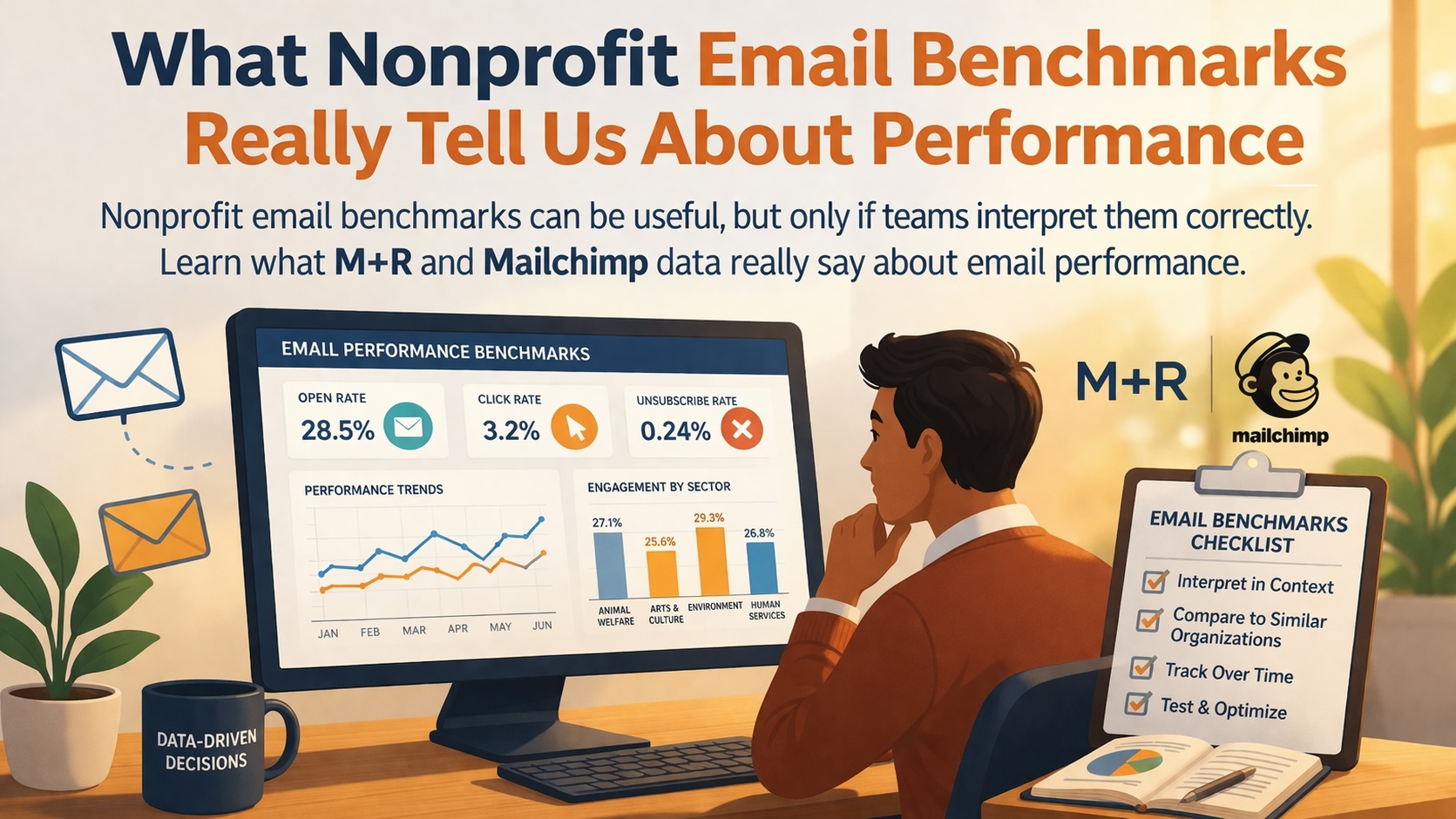
Email benchmarks are attractive because they promise clarity. A team can compare itself to the sector, decide whether it is ahead or behind, and make quick decisions about performance. Used carefully, benchmarks are valuable. Used casually, they can mislead.
The challenge is that modern nonprofit email performance cannot be reduced to one number.
Mailchimp's benchmark data currently shows nonprofits with relatively strong average open and click rates compared with many industries. M+R Benchmarks, however, offers a more specifically nonprofit view and paints a more nuanced picture: email list sizes increased in 2024, but email revenue declined on average; nonprofits sent more email messages per subscriber; and for every 1,000 fundraising emails delivered, organizations raised an average of $58, down from the prior year. M+R also reported an average fundraising click-through rate of 0.48 percent and a page completion rate of 12 percent.
Those numbers do not mean email is weak. They mean email should be interpreted in context.
A benchmark is a reference point, not a verdict
The first mistake teams make is treating any benchmark as a target that applies universally.
But nonprofit audiences differ widely by mission, donor age, acquisition source, brand strength, and message purpose. An advocacy email, a major donor note, a monthly donor welcome sequence, and a last-chance fundraising appeal should not be expected to perform the same way. Nor should a local arts organization and an international humanitarian nonprofit assume they are solving the same attention problem.
Benchmarks are most useful when they prompt better questions:
· Are we trending up or down over time?
· Are we sending too much of the wrong content?
· Are specific segments underperforming?
· Are our clicks healthy but our landing pages weak?
· Are our opens inflated but our actual actions flat?
Used this way, a benchmark becomes diagnostic rather than performative.
Open rates still matter, but less than they used to
Mailchimp is explicit that open and click metrics can be distorted by bot activity and Apple's Mail Privacy Protection. The company recommends excluding Apple MPP and other bot activity for more accurate reporting, and it notes that opens are measured through image loading, which has never been perfectly reliable.
That does not make open rate useless. It does make it insufficient.
Subject line testing, audience fit, and broad delivery health can still be informed by opens, but teams should be careful about drawing strong conclusions from open rate alone. Clicks, conversions, completion rate, unsubscribe behavior, and downstream giving are often more trustworthy indicators of whether the email actually worked.
The more important M+R finding may be about efficiency, not vanity metrics
One of the strongest lessons from M+R's 2025 email data is that more email did not necessarily produce better fundraising outcomes. Organizations sent more messages per subscriber, yet average email revenue declined and revenue per 1,000 fundraising emails fell.
That should prompt reflection.
Many nonprofits do not have an email problem so much as a relevance problem. If every important audience receives the same calendar, the same broad copy, and the same cadence, the list may continue growing while the economics of the program weaken.
The answer is usually not silence. It is greater relevance.
Clicks and completion tell a more actionable story
If a fundraising email earns clicks but the donation page does not convert, the issue may not be the message. If the donation page converts but the wrong people are clicking, the segmentation may be weak. If the click-through rate is low across the board, the content or offer may not be clear enough.
This is why email should be evaluated as part of a journey. The email itself is only one step. The landing page, donation form, confirmation, and follow-up all contribute to the real outcome.
For nonprofit teams, this integrated view is far more useful than debating whether a 38 percent open rate or a 42 percent open rate is "good."
The right benchmark depends on the type of email
A practical email program should compare like with like. Examples include:
· newsletters versus newsletters
· event reminders versus event reminders
· fundraising appeals versus fundraising appeals
· post-event follow-up versus post-event follow-up
· automated welcome sequences versus automated welcome sequences
Without that discipline, average performance becomes noisy and hard to act on. A healthy program is rarely one where every email performs the same. It is one where each email type is serving its role effectively.
Benchmarks should also shape expectations across the organization
One reason benchmark misuse persists is that leadership teams sometimes expect email to solve too many problems at once. Email can acquire, steward, convert, remind, and report. But those jobs require different message types and different measures of success.
If the only question leaders ask is, "How did the email perform?" teams may default to simplistic metrics. Better governance asks, "What job was this email trying to do, and did it do that job well?"
That is a much better use of benchmark data.
A useful email standard for nonprofit teams
Use benchmarks as orientation, not identity.
Know what Mailchimp and M+R say. Review your trends. Normalize for audience type. Look past opens when privacy and bot activity distort them. Compare email performance to landing-page and donation-page behavior. And judge the program by whether it is creating movement, not only activity.
That is what the best nonprofit teams do. They use benchmarks to sharpen judgment, not replace it.
Email performance becomes easier to improve when the data around donations, registrations, and follow-up lives closer together. Altrinum helps nonprofits connect outbound communication with the transactions and journeys that matter afterward.

