What a Modern Donation and Event Platform Should Actually Solve
It is easy to describe nonprofit software by feature inventory. Donation forms. Event registration. Ticketing. Email tools. Receipts. Reports. The problem with that approach is that it tells buyers what a platform contains, not what it resolves.
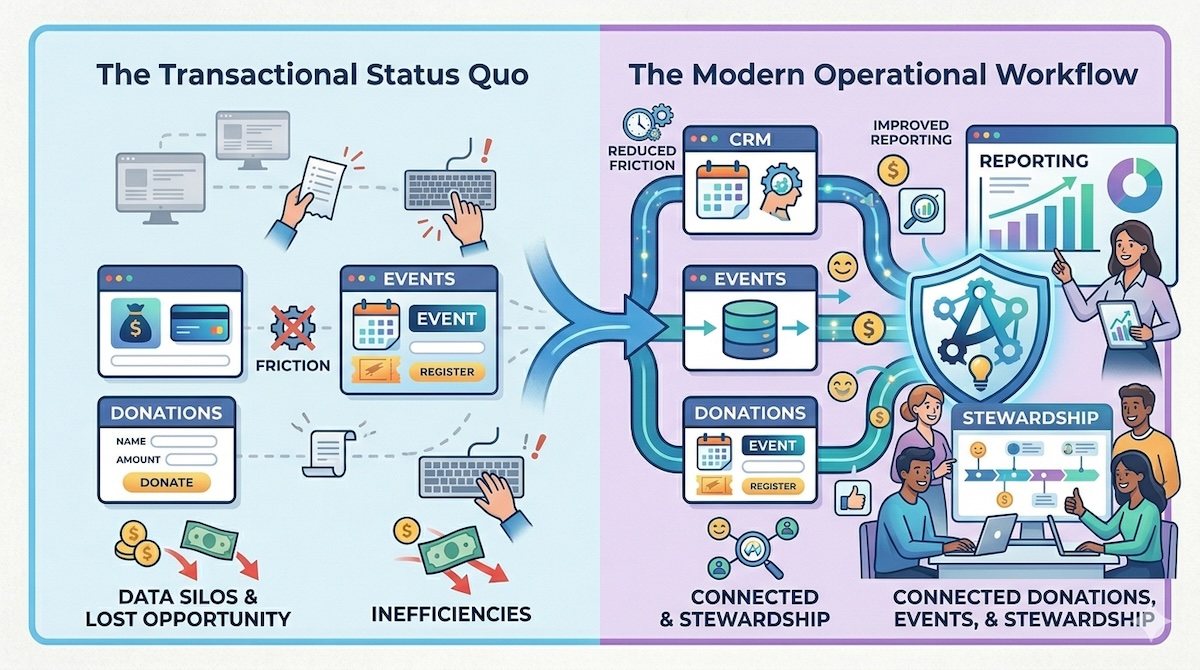
Most organizations do not struggle because they lack a page where donations can be accepted or an online form where a guest can register. They struggle because the work around those transactions is still manual, inconsistent, or fragmented. The handoff from registration to attendance is weak. The handoff from payment to acknowledgment is slow. The handoff from event participation to donor stewardship is incomplete.
A modern donation and event platform should solve those handoffs.
That is the standard buyers should use when evaluating software in 2026. Not whether a system can technically perform a task, but whether it reduces operational friction across the entire donor and participant journey.
The first job is to reduce avoidable friction
M+R Benchmarks continues to show that nonprofit digital performance depends heavily on small details in the user journey. More than half of nonprofit web traffic now comes from mobile devices, yet desktop still accounts for most donation revenue, and average gift size on desktop remains significantly higher than on mobile. That does not mean mobile matters less. It means nonprofit teams still have work to do in reducing mobile friction and increasing confidence during the giving process.
A strong platform should help by making a few things easy:
clean, fast forms that work well on phones
clear support for one-time and recurring giving
practical payment choices, including digital wallets where appropriate
predictable registration flows for paid and free events
reliable confirmation, acknowledgment, and follow-up messages
These are not decorative improvements. They determine whether a supporter completes the action they intended to take.
The second job is to preserve context
A platform should also make the transaction legible to the organization after it happens.
That is where many tools fall short. A donor gives, but the campaign information is incomplete. A guest registers, but attendance and no-show behavior do not flow back into the same constituent view. Finance can confirm revenue, but development cannot easily distinguish ticket value from gift value, or stewardship cannot see which event relationships later converted into donations.
For nonprofit teams, context is what turns activity into strategy. Without it, the organization keeps generating records but struggles to generate learning.
This is especially important at a time when the fundraising environment is increasingly uneven. Blackbaud Institute and FEP reporting both point to resilience in charitable giving, but also to concentration: larger gifts and better-resourced organizations are performing differently from smaller-donor segments. In that kind of market, organizations need systems that help them cultivate relationships intentionally, not simply log transactions after the fact.
The third job is to support operational trust
One of the most underrated traits in nonprofit software is trustworthiness inside the team.
Can finance trust the receipt logic? Can advancement trust the report definitions? Can event staff trust the check-in list? Can the communications team trust the segment criteria? If the answer is no, staff create workarounds. Once that happens, even good software loses value because the organization stops treating it as authoritative.
A modern platform should therefore make the underlying workflow clearer, not more mysterious. Users should understand how a registration became a payment, how a payment became an acknowledgment, and how that record appears in reporting. The strongest products do not merely automate. They create confidence.
The fourth job is to strengthen follow-up
Many nonprofit transactions are treated as endpoints when they should be treated as beginnings.
An event registration should begin a communication journey. A first gift should begin a stewardship path. A completed attendance record should trigger a post-event sequence that reflects what the participant actually did, not just what they purchased.
That is why platforms that combine operational workflows with communications context are often more valuable than point solutions that optimize a single step. The question is not whether an email can be sent from another tool. It is whether the right email, with the right context, can be sent without a week of data handling.
What buyers should ask instead of asking for more features
When nonprofit teams evaluate software, they often ask, "Does it have X?" That is understandable, but not sufficient. Better questions include:
What manual work disappears if we use this platform well?
Which data handoffs become simpler or more reliable?
Can we support both fundraising and events without duplicating constituent records?
How does the system handle acknowledgments, advantages, and post-transaction communication?
Will this improve reporting quality for finance and leadership, not just user convenience?
Can a lean team run the system without building an ecosystem of side spreadsheets?
Those questions force the conversation back to operating reality, which is where software value is either proven or lost.
What this means for modern nonprofit teams
A truly modern donation and event platform is not just a front-end experience. It is a way of reducing the distance between supporter action and organizational understanding.
That matters because nonprofit teams rarely have the luxury of large, specialized departments. The same group often has to manage campaigns, events, data hygiene, stewardship, reporting, and vendor coordination. A platform should lighten that burden by making the core workflows more coherent.
That is the standard worth buying against.
The best platforms do not simply help an organization accept money or sell tickets online. They help the organization move from transaction to trust, from activity to insight, and from fragmented effort to repeatable process.
If your current tools can process donations and registrations but still leave your team reconciling records, fixing exports, and manually managing follow-up, the platform may not be solving the right problem. Altrinum is designed to connect the work before and after the transaction as well.

