The Hidden Cost of Disconnected Nonprofit Systems
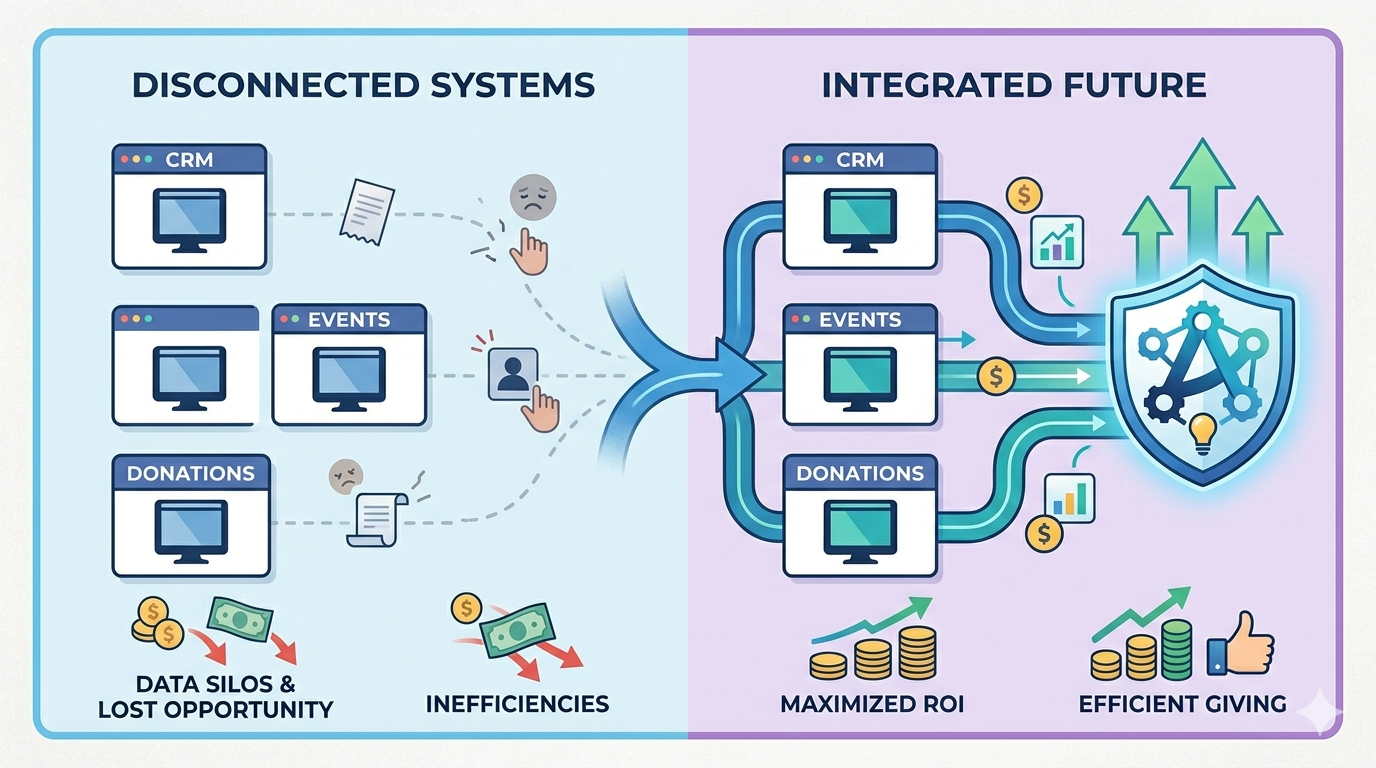
For many nonprofit teams, software sprawl does not arrive as a dramatic strategic decision. It happens quietly. A donation form is added because the old one feels dated. An event registration tool is chosen because it solves an immediate deadline. A separate email platform stays in place because staff already know how to use it. Finance exports data into spreadsheets because the source systems do not line up cleanly enough to trust.
On paper, each decision can look reasonable. In practice, the accumulated effect is often costly. The fundraising team does not have a complete view of donor activity. Event staff cannot easily see whether a registrant is also a recurring donor. Finance spends days reconciling records that should already agree. Leadership sees headline numbers, but not always the operational friction sitting underneath them.
This matters even more in the current giving environment. Recent Blackbaud Institute reporting found that the typical nonprofit saw revenue growth in 2025, but the gains were uneven and often concentrated among organizations with stronger capacity and larger gifts. Fundraising Effectiveness Project reporting has shown a similar pattern: dollars have held up better than donor counts, while smaller donor segments remain under pressure. In a market like that, operational inefficiency is not just an inconvenience. It becomes a structural disadvantage.
Fragmentation creates cost long before it creates a crisis
Most organizations recognize the pain of bad systems only when a major project goes wrong. A receipt is incorrect. A waitlist promotion fails. A campaign goes out to the wrong segment. A donor receives three emails from three systems that do not know about each other. Those incidents are visible, so they get attention.
The more expensive damage is usually quieter.
It shows up when staff begin to build workarounds into the culture of the organization. People export lists because they do not trust the report. They maintain shadow spreadsheets because the dashboard feels incomplete. They delay follow-up because matching records across tools takes too long. Over time, the organization starts paying a tax in labor, decision speed, and confidence.
That tax is especially high in nonprofit environments because the same constituent often moves across multiple journeys. A person might attend an event, make a one-time donation, subscribe to emails, become a monthly donor, and later bring a colleague to a stewardship event. When systems are disconnected, the organization tends to see five separate transactions rather than one developing relationship.
The real issue is not convenience. It is stewardship.
Disconnected tools weaken stewardship because they interrupt context. The team writing the follow-up email may not know that a donor upgraded their gift last month. The person at check-in may not know that a guest is also a board prospect. The finance office may not have enough confidence in event advantages, tax treatment, or acknowledgment language because the underlying data arrived from several places with different logic.
That is why fragmented architecture often produces inconsistent donor experience. The problem is not that staff do not care. It is that the organization has made it difficult for them to act on what they know.
When donor counts are harder to grow and retention is harder to sustain, consistency matters. Small lapses compound. A delayed thank-you, a clumsy registration experience, or a report that cannot be trusted may not cause immediate revenue loss on its own, but together they erode confidence and make it harder to build long-term value.
What the hidden cost usually looks like inside the organization
The signs are usually familiar.
First, reporting becomes an argument about definitions. One system says an event attendee donated. Another says they registered. A third contains the payment record. Leadership meetings drift into reconciliation instead of decision-making.
Second, staff time moves away from relationship work and into record maintenance. Instead of designing segmentation, stewardship, or campaign strategy, capable people spend their time fixing imports, checking duplicate records, and validating exports.
Third, important workflows become person-dependent. One administrator knows how to get the event data into the CRM. Another knows how to fix acknowledgment wording for certain gifts. Someone in finance knows which spreadsheet is actually right. This creates institutional risk, especially for lean teams.
Fourth, digital performance suffers in ways that are hard to diagnose. M+R Benchmarks continues to show how much nonprofit performance depends on conversion details, mobile behavior, and recurring-gift design. If the stack is fragmented, those optimizations become harder because each system owns only one small part of the experience.
What a better operational model looks like
The answer is not necessarily buying fewer tools for the sake of simplicity. The answer is creating a cleaner operating model for constituent data and mission-critical workflows.
For most nonprofits, that means a few practical commitments:
Donor, registrant, payment, and communication records should be easy to relate to one another
Acknowledgment and receipting logic should not live in disconnected manual processes
Reporting should draw from a system that is operationally close to the work, not just analytically convenient
Event operations, fundraising, and communications should share enough context to support timely follow-up
Staff should be able to explain how data moves without needing a whiteboard and three exports
Notice that none of this is especially glamorous. But it is the foundation that allows a team to become more effective without simply becoming busier.
Where this becomes a strategic advantage
Organizations often evaluate technology as a procurement question. The more useful framing is operational. Does the system design help the organization build trust, move faster, and steward donors with more context?
That is where integrated platforms begin to matter. Not because every nonprofit needs one giant system for everything, but because the highest-value workflows are usually the ones that cross traditional departmental lines: a donation tied to an event, a follow-up journey tied to attendance, a finance review tied to campaign behavior, a stewardship plan tied to real constituent history.
If those workflows remain stitched together by exports and memory, the organization will keep paying for the fragmentation whether or not it appears in the software budget.
The hidden cost of disconnected systems is not merely inefficiency. It is lost clarity. And when clarity is lost, so is speed, consistency, and often donor confidence.
If your team is spending too much time reconciling donations, registrations, and follow-up activity across separate tools, it may be time to simplify the operating model. Altrinum is built to help nonprofits manage giving, events, and communications with less duplication and better context.

