How to Send More Relevant Nonprofit Emails Without Burning Out Your List
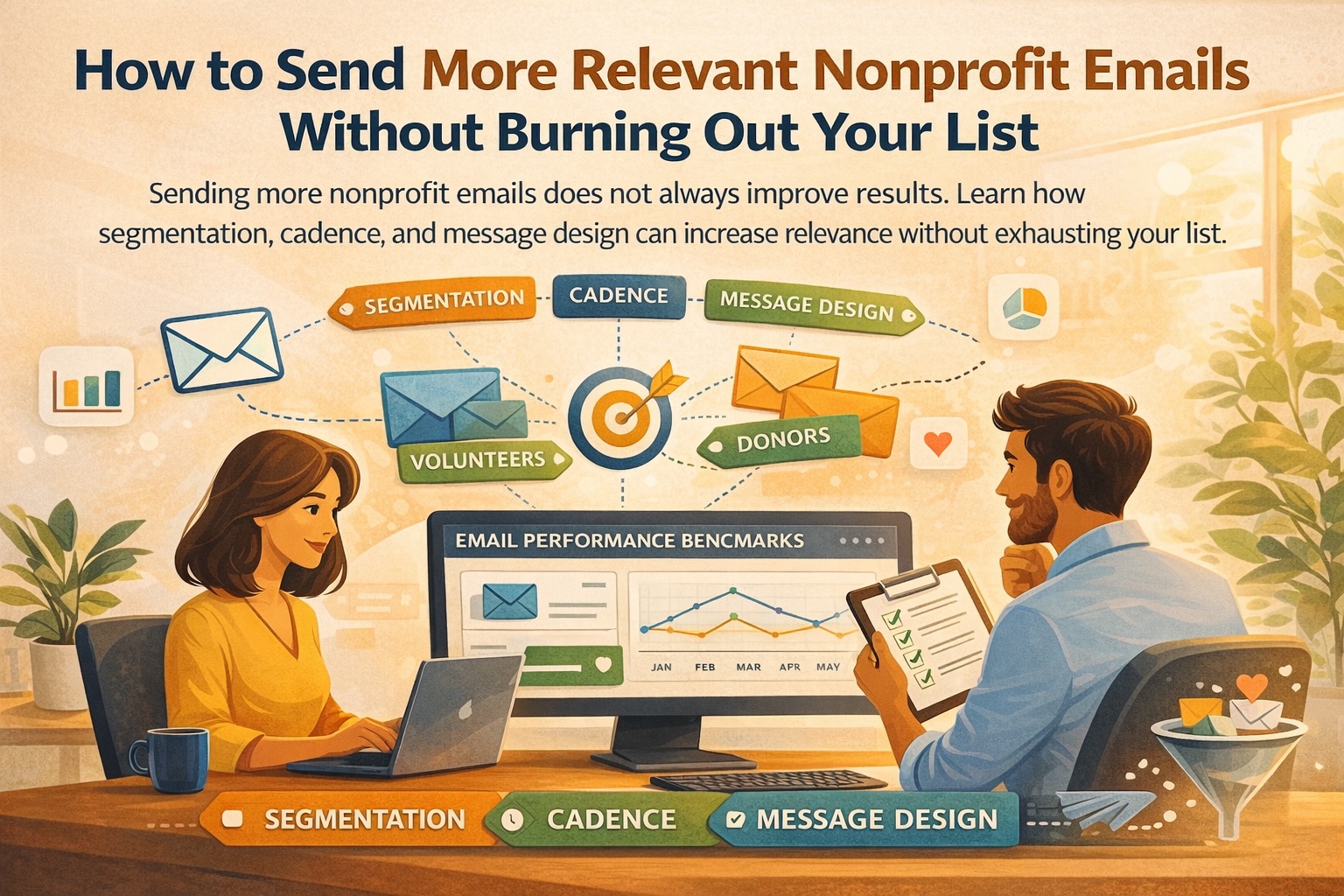
Many nonprofit teams know what list fatigue feels like long before they can prove it in a dashboard. Fewer clicks. More unsubscribes. More internal anxiety about whether to send one more reminder. More pressure to "do another email" because the campaign still needs revenue.
The temptation is to treat frequency as the main variable. Sometimes it is. Often it is not.
Mailchimp's own guidance notes that if performance is low even with clear subject lines and decent targeting, send frequency is worth testing. M+R's 2025 email findings add another layer: nonprofits sent more messages per subscriber in 2024, but email revenue still declined on average. That does not mean more email is always harmful. It does mean that more email without more relevance is unlikely to solve much.
The real challenge is not simply how often to send. It is how often to send the right thing to the right people.
Relevance starts with audience clarity
The fastest way to exhaust a list is to behave as though every subscriber joined for the same reason.
In reality, nonprofit audiences are diverse. Some donors want direct fundraising appeals. Some supporters respond best to reporting and mission updates. Event attendees may care more about invitations and reminders. Volunteers may be more responsive to participation opportunities. Recent first-time donors may need trust-building more than urgency.
If all of these groups receive the same sequence, the organization may preserve efficiency in the short term while weakening trust over time.
This is why segmentation is foundational, not advanced. Mailchimp explicitly recommends segmenting audiences by interests, location, or actions so that people receive information that is actually useful to them. For nonprofits, behavioral segmentation is often the most powerful starting point because it reflects what supporters have done, not just who they are on paper.
Content fatigue is often a planning problem
Teams frequently blame fatigue on over-sending when the deeper issue is content sameness.
Three emails in a week can be entirely reasonable if each one serves a distinct purpose and reaches an appropriate segment. One bland, repetitive message sent to the whole database can do more damage than all three.
Useful nonprofit email calendars usually include a mix of:
· stewardship and reporting content
· event-related logistics and invitations
· urgent but credible fundraising asks
· automated confirmations and welcomes
· stories that explain progress, not just need
What drains a list is not volume alone. It is the feeling that every message asks for attention without earning it.
Cadence should follow relationship stage
One of the simplest ways to improve relevance is to send according to where the supporter is in the relationship.
A new donor may need a short welcome sequence. A recurring donor may need occasional impact updates and a lighter ask cadence. An event registrant may need operational reminders close to the date and a tailored follow-up afterward. A long-lapsed supporter likely needs a different tone from an active one.
When cadence reflects relationship stage, the same total number of messages can feel far more natural.
Look beyond opens when judging fatigue
Because of privacy and bot activity, open rates are no longer the clean signal they once seemed to be. Mailchimp notes that Apple MPP and similar bot behavior can falsely inflate both open and click metrics, which means teams should read headline rates cautiously.
Instead of relying on opens alone, watch for patterns such as:
· declining click-through rate by segment
· higher unsubscribe rates after specific message types
· weaker page completion after fundraising emails
· lower revenue per 1,000 fundraising emails delivered
· stronger results from smaller, better-targeted segments than from whole-list sends
Those patterns usually reveal fatigue more clearly than a single top-line metric.
Strong email programs reduce the need for last-minute over-sending
Some list fatigue is self-inflicted by weak upstream planning. If a campaign relies too heavily on late reminders because segmentation, landing-page conversion, or earlier stewardship were underdeveloped, the list ends up absorbing the stress of those missed opportunities.
A better strategy is to design stronger journeys before the pressure rises. That might include:
· warming important segments before a major appeal
· using event participation as a signal for future asks
· improving post-gift or post-registration automation
· strengthening landing pages so clicks convert more efficiently
· using different message types for different donor stages
When the broader system works better, the email program does not need to compensate by shouting louder.
Relevance also means respecting accessibility and clarity
Mailchimp's guidance on link text is especially relevant here. It recommends avoiding vague phrases like "click here" because they are unhelpful for accessibility and unclear to readers. That point is easy to overlook, but it gets at a deeper truth: relevance is also a matter of language.
Supporters should be able to understand the message, the action, and the destination quickly. Clear copy, descriptive links, and focused calls to action do more for engagement than decorative complexity.
A better operating question for nonprofit teams
Instead of asking, "How many emails should we send?" a better question is, "What communications would feel appropriate and useful to this segment over the next 30 days?"
That is a more strategic frame. It pushes teams to think about audience, purpose, and trust rather than calendar pressure alone.
In practice, the organizations with the healthiest email programs are rarely the ones that send the least. They are the ones that understand why each message exists, who it is for, and what should happen next.
That is the real antidote to list fatigue.
Better email performance does not come from volume alone. It comes from cleaner segmentation, better transaction context, and stronger follow-up logic. Altrinum helps nonprofits connect those pieces so communication can be more relevant from the start.

