Donor Retention Is a Leadership Issue, Not Just a Fundraising Metric
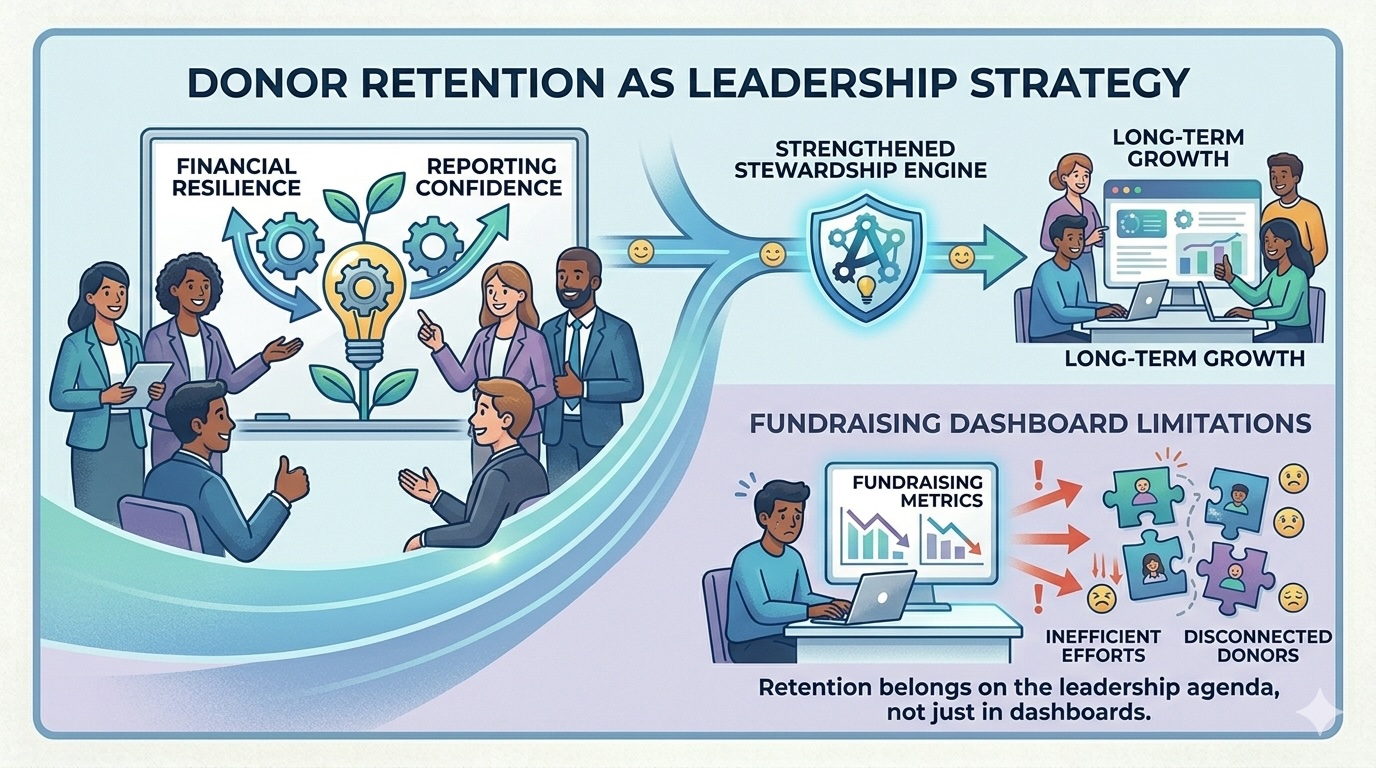
Donor retention is often treated as a specialist metric, something the development team watches while the rest of the organization focuses on revenue, programs, and year-end targets. That separation is understandable, but it is increasingly unhelpful.
Retention is not a narrow fundraising concern. It is a leadership issue.
The reason is straightforward. Retention influences revenue predictability, acquisition efficiency, stewardship quality, staff workload, and the credibility of long-term planning. When retention weakens, the entire organization pays for it, even if the immediate symptom appears in a fundraising report.
Recent Fundraising Effectiveness Project data underscores the point. Through Q3 2025, overall donor retention improved only slightly, while donor counts remained under pressure. The same reporting showed a stark difference between donor groups: repeat donors were retained at far higher rates than new donors, and micro donors had much lower retention than larger donor segments. In Q1 2025, FEP also found that the steepest retention declines were among smaller donor groups.
Those are not merely statistics for development teams. They describe the health of the organization's future pipeline.
Why retention belongs in leadership conversations
An organization with weak retention has to keep replacing itself.
That is the simplest way to understand the issue. If too many donors leave after one gift, every new campaign must first refill what has already leaked away. This creates pressure to spend more on acquisition, put more weight on year-end fundraising, and celebrate gross growth that may be masking underlying churn.
Leadership teams often focus on topline revenue because it is visible and necessary. But topline revenue without attention to retention can create a false sense of strength. A campaign can appear successful while leaving the donor base more fragile than before.
Retention therefore belongs in executive and board-level review for the same reason staff turnover or deferred maintenance does: it affects the institution's long-term resilience.
Retention is a measure of organizational coherence
Many teams talk about retention as though it were only a function of thank-you letters and appeal cadence. Those matter. But retention is also shaped by operational coherence.
Did the donor have a smooth giving experience? Was the acknowledgment timely and accurate? Did follow-up reflect what they actually did? Could the organization recognize them across events, campaigns, and channels? Did the next communication feel earned, or did it feel like the system had forgotten them?
In other words, retention is partly the outcome of how well the organization works together.
This is why software design, reporting quality, and stewardship operations affect retention more than they are often given credit for. Donors do not experience your departments separately. They experience the organization as one relationship.
Smaller donors deserve more strategic attention than they often receive
FEP's 2025 data should be a warning to organizations that have grown too comfortable relying on larger gifts for momentum. Micro donors represented a very large share of the donor base while also showing the weakest retention rates. That does not mean every small donor should receive the same stewardship investment as a major donor. It does mean that neglecting this group risks long-term erosion.
Smaller donors matter not only because of their aggregate revenue, but because they represent future optionality. Some become recurring donors. Some upgrade. Some become event participants, volunteers, advocates, or legacy prospects. A donor base cannot remain healthy if too much of its broad participation disappears at the bottom.
Leadership should therefore ask not only, "How much did we raise?" but also, "Which parts of our donor base are we keeping, and which are we quietly losing?"
The retention conversation should move beyond averages
Average retention rates are useful, but they can hide as much as they reveal. A more disciplined conversation looks at segments.
For example:
· new donor retention
· repeat donor retention
· recurring donor retention
· retention by gift size
· retention by acquisition source
· retention after event participation
· retention after specific campaign types
This level of visibility changes what the organization can do. It becomes possible to see whether a problem is really a first-year stewardship problem, an event conversion problem, a low-dollar donor problem, or a data integrity problem masquerading as churn.
Leadership does not need to manage every segment directly. But leadership does need the organization to surface the right questions.
Retention improves when the organization stops treating the gift as the finish line
One of the most common reasons retention suffers is that the internal workflow ends too soon. A donation is processed. A receipt is sent. The supporter returns to silence until the next campaign.
That is not stewardship. It is transaction management.
Retention improves when the organization thinks in journeys rather than isolated asks. A first-time donor should enter a path that explains impact, builds trust, and anticipates the next reasonable step. Event attendees should receive follow-up informed by attendance, not generic blasts. Monthly donors should receive a distinct welcome and ongoing relationship communications. Lapsed donors should be approached differently from never-gave-again donors.
Those practices sound straightforward because they are. What makes them difficult is usually operational fragmentation, not lack of goodwill.
A leadership agenda for better retention
Retention gets stronger when leadership helps create the conditions for it.
That includes:
· making retention part of regular performance review, not an annual afterthought
· expecting segmented analysis, not only topline percentages
· resourcing stewardship and follow-up, not just acquisition
· reducing the operational friction that makes donor context hard to use
· aligning finance, development, events, and communications around a common constituent record where possible
When retention is treated as a shared institutional responsibility, the organization begins to make different technology, staffing, and process choices.
That is why retention is a leadership issue. It sits at the intersection of culture, systems, and strategy. And in a climate where donor growth is uneven, the organizations that manage that intersection well will be more durable than those that simply keep spending to replace the donors they already had.
Retention improves when teams have better visibility into donor history, event participation, and follow-up actions. Altrinum is built to help nonprofits connect those signals so stewardship can be more timely, accurate, and relevant.

