Building a Single Source of Truth for Donors, Registrants, Payments, and Communications
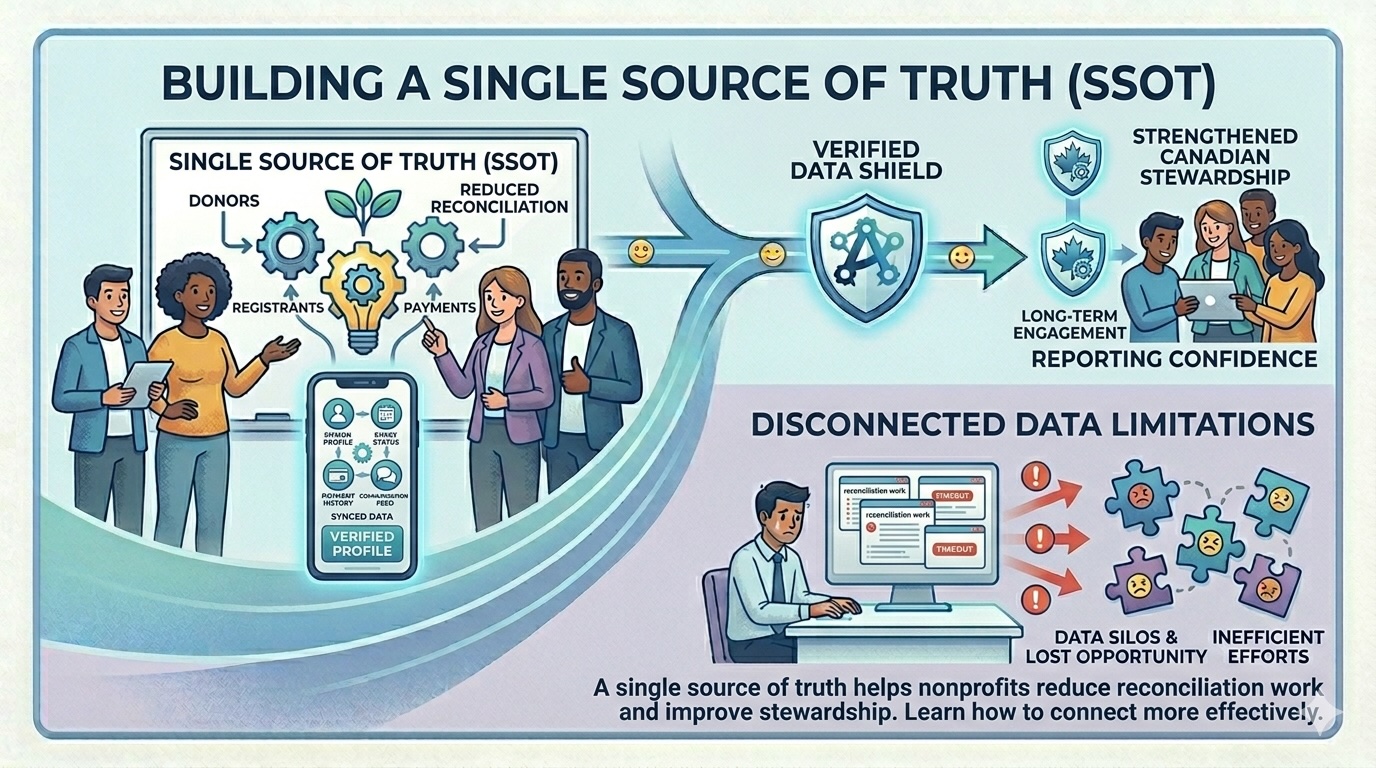
"Single source of truth" is one of those phrases that can sound more ambitious than useful. For nonprofit teams, however, the concept is less abstract than it seems. It describes a practical operational condition: when staff across fundraising, events, communications, and finance can rely on the same underlying record of what happened.
Without that condition, every team develops its own version of reality.
The donation system becomes the source for one question. The event platform becomes the source for another. The email tool becomes the source for engagement history. Finance maintains a spreadsheet because none of the above lines up exactly. Staff do their best to reconcile the differences, but the organization slowly loses both time and confidence.
A single source of truth does not mean one database must do literally everything. It means the organization has intentionally decided where authoritative records live for its most important workflows.
Start with the workflows that create the most confusion
Most nonprofits do not need to solve every data problem at once. The better approach is to focus on the workflows where fragmentation causes repeated operational cost.
These are usually the same across organizations:
· donations and donor records
· event registrations, guest details, and attendance
· receipts or acknowledgments and payment history
· segmentation and outbound communications
· leadership and finance reporting
If those records are inconsistent, the organization feels it everywhere.
What a source of truth should do
A genuine source of truth should make a few things possible without unusual effort:
· identify the constituent accurately across different forms of engagement
· connect a transaction to the person, event, campaign, or message that produced it
· distinguish between registered activity and completed activity, such as attendance
· support reliable follow-up without exporting data through several tools first
· provide reporting that different departments can understand and defend
This is not mainly about analytics. It is about operational trust.
If staff still need to ask which system is right every time a report looks surprising, then the organization does not yet have a true source of truth.
The problem is often not missing data but duplicated interpretation
Many organizations already have most of the data they need. What they lack is consistent interpretation.
A payment exists in one system. A constituent profile exists in another. The campaign source is stored elsewhere. The event registration adds guest data that never becomes part of the same relationship history. Then, because none of those pieces align neatly, staff build local rules and shadow processes to make sense of the record.
Over time, the organization stops debating data and starts debating meaning.
That is why source-of-truth work is partly a governance exercise. Teams need clarity on which system owns which field, which statuses are authoritative, and how corrections are made.
Why this matters more in today's fundraising environment
When fundraising growth is uneven and smaller donors are harder to retain, organizations need more precision, not less. FEP and Blackbaud reporting both suggest that long-term health depends on more than headline revenue. It depends on understanding what kinds of donors and participants are being acquired, retained, and developed.
That understanding requires more than dashboards. It requires constituent records that can be trusted across events, giving, and communications.
If a team cannot easily see that an event guest became a first-time donor, or that a recurring donor also attended a stewardship event, the organization is leaving context unused. That context is where much of the real strategic value sits.
A strong source of truth also reduces cultural friction
Technology fragmentation is often discussed as a systems problem. It is also a collaboration problem.
When teams work from different records, misalignment becomes personal. Finance appears too cautious. Fundraising appears too imprecise. Events appears too tactical. Communications appears disconnected from relationship history. In reality, these tensions are often produced by the architecture, not the people.
A stronger source of truth reduces that friction because teams can begin from shared facts. They may still interpret them differently based on role, but they are no longer arguing over whether the attendee count, donor status, or payment total is real.
What to implement first
Organizations trying to improve source-of-truth discipline should begin with a few practical priorities:
· define the authoritative constituent record
· define the authoritative payment and acknowledgment record
· ensure event attendance status is captured distinctly from registration status
· align segmentation fields with real organizational use, not theoretical future use
· reduce manual re-entry wherever possible
· document correction workflows so data hygiene does not depend on memory
This is not glamorous work, but it is the kind of infrastructure that lets a nonprofit scale without losing credibility internally.
The goal is not data perfection. It is dependable decision-making.
A single source of truth is valuable because it makes the next action clearer. Who should be thanked? Who should be invited? Which report should the board trust? Which donors are truly new, repeat, recurring, or lapsed? Which event participants are worth deeper follow-up?
When those questions can be answered with confidence, staff spend less time reconciling and more time acting.
That is what nonprofit data architecture should ultimately enable.
If your team is still reconciling donors, registrations, payments, and communication history across separate tools, the cost is not only technical. It shows up in stewardship, reporting, and staff confidence. Altrinum helps nonprofits bring those core workflows into a cleaner operating model.

