A Practical Guide to Receipting in Canada and Acknowledgments in the United States
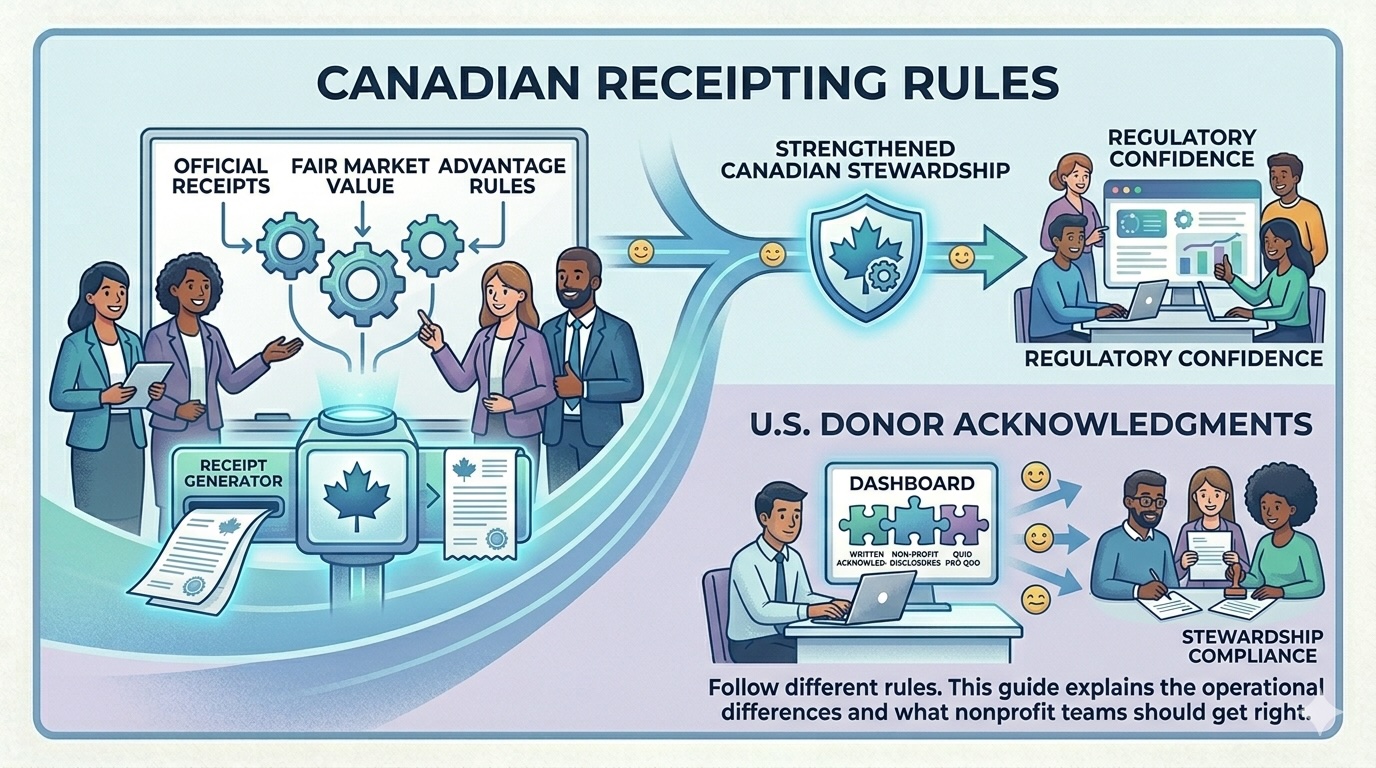
Receipting is one of those nonprofit workflows that looks straightforward until the organization starts operating at scale. A gift is made. A document is issued. The donor moves on. In reality, receipting and acknowledgment sit at the intersection of tax law, donor trust, finance operations, and data quality.
The complexity increases for organizations operating across Canada and the United States, or for software teams and service providers supporting organizations in both markets. The underlying principles are similar - accuracy, timeliness, and clear records - but the compliance framework is not the same.
That distinction matters. A Canadian charity issuing official donation receipts is operating under a different regime from a U.S. nonprofit providing a written acknowledgment for deductible contributions. Teams that blur the two often create risk, confusion, or both.
In Canada, the official receipt is a regulated tax document
For Canadian registered charities, receipting is governed by specific Canada Revenue Agency requirements. The CRA makes clear that an official donation receipt may be issued only for gifts that legally qualify as gifts, and that the receipt must contain prescribed information. The CRA's receipting checklist details required elements such as the charity's legal name and address, registration number, serial number, place of issue, dates, donor name and address, the amount of the gift, the value and description of any advantage, the eligible amount, and the signature of an authorized individual. For non-cash gifts, additional information may be required, including property description and appraiser details where applicable.
That is a much more structured framework than many organizations assume. It also means receipting is not something teams should improvise with ad hoc templates and inconsistent data entry.
The CRA also emphasizes the importance of identifying the true donor, maintaining adequate books and records, and handling fundraising events carefully. If an event includes benefits or advantages, the eligible amount may differ from the gross payment. That distinction is not optional. It is part of the receipting logic.
In the United States, the document is usually an acknowledgment, not a formal tax receipt
In the U.S., the operational language is different. IRS Publication 1771 and related guidance focus on substantiation and disclosure requirements. A donor generally needs a written acknowledgment from the charitable organization for a single contribution of $250 or more in order to claim a deduction. For quid pro quo contributions over $75, the charity must provide a written disclosure statement that explains the deductible portion and gives a good-faith estimate of the value of goods or services received.
This means U.S. organizations are not typically issuing the same kind of formal tax receipt document used by Canadian charities. Instead, they are providing written acknowledgments and disclosure statements that help donors substantiate deductions.
That may sound like a semantic difference, but it affects document design, terminology, internal training, and donor communication. Canadian teams often speak naturally about tax receipts. U.S. teams often need to speak more precisely about acknowledgments and quid pro quo disclosure.
The operational risk is usually in the edge cases
Simple cash gifts are rarely where teams run into trouble. Problems emerge at the edges:
· event tickets that include a meal, performance, or other advantage
· sponsorships where the transfer may not be a pure gift
· auction purchases where the deductible portion must be separated from fair market value
· non-cash gifts requiring valuation support
· replacement or corrected documents
· payments made by one person on behalf of another
· gifts flowing through platforms where the constituent and payment data do not align cleanly
These cases are exactly why receipting and acknowledgment should be handled as part of a governed process rather than a last-step administrative task.
The data model matters more than many teams realize
In practice, good receipting starts well before the document is issued. The organization needs the correct data about donor identity, payment amount, benefit value, gift type, date, campaign context, and issuing authority. If those fields are missing or inconsistent upstream, staff are forced to fix the problem manually at the point of issuance.
That is inefficient, but more importantly, it is risky. Teams under pressure may make reasonable assumptions that should actually have been resolved earlier in the workflow.
This is one reason integrated nonprofit systems can add so much value. When the donation, event, and acknowledgment logic are closer together operationally, staff are less likely to reconstruct the record from several places.
Language matters just as much as compliance
Even when the document is technically compliant, poor wording can create donor confusion.
In Canada, donors should see language consistent with an official donation receipt for income tax purposes. In the U.S., donors should see language consistent with written acknowledgment and, where applicable, quid pro quo disclosure. Organizations operating in both markets should resist the temptation to use one generic template for everyone. The legal logic differs, and the donor-facing language should reflect that.
This is particularly important for software products and nonprofits that aspire to North American reach. Cross-border support is not just a currency setting. It requires careful treatment of document type, content, naming, and audit trail.
A practical operating standard for nonprofit teams
Teams can reduce both risk and workload by building around a few principles:
· decide document type by jurisdiction and gift context, not habit
· capture donor, payment, and advantage information upstream
· separate gross payment from eligible or deductible amount where required
· use controlled templates rather than manual edits
· maintain a reliable audit trail for corrections and reissues
· coordinate finance and fundraising ownership instead of leaving the process in a grey zone
The goal is not only compliance. It is confidence. Donors should receive documents that are timely, clear, and appropriate to their jurisdiction. Staff should be able to explain why the document says what it says.
That is what mature receipting looks like.
If your team is handling receipting or donor acknowledgments across different workflows, currencies, or jurisdictions, the process should not depend on manual interpretation every time. Altrinum helps nonprofits manage donations, events, and document workflows with cleaner operational logic.

